ERP Is Changing. The Goal Is Still a Stronger Business.

What SuiteWorld 2026 means for Australian and New Zealand businesses managing margins, cash flow and operational complexity.

Running a profitable business takes more than knowing how much revenue is coming in.

You need to know what it costs to deliver that revenue, where your cash is committed, which jobs are performing as expected and whether today’s decisions are creating tomorrow’s problems.
 
For Australian and New Zealand businesses, those questions have become particularly important.
 
In Australia, annual inflation reached 4.3% in September 2026, while NAB’s latest business survey reported purchasing costs continuing to rise faster than final selling prices. Across New Zealand, businesses are facing a different but related challenge, with the September 2026 NZIER survey finding that 64% of firms identified insufficient sales as their main business constraint.
 
For businesses managing equipment, inventory, projects and field operations, these pressures affect everyday decisions. How much stock should we purchase? Can we recover a supplier price increase? Is a job still profitable? When will completed work turn into cash?
 
Technology can help answer those questions, but the quality of the answers depends on how well your business information, processes and people work together. That brings us to an interesting development from Oracle NetSuite’s SuiteWorld 2026.

ERP as we know it is over. What does that actually mean?

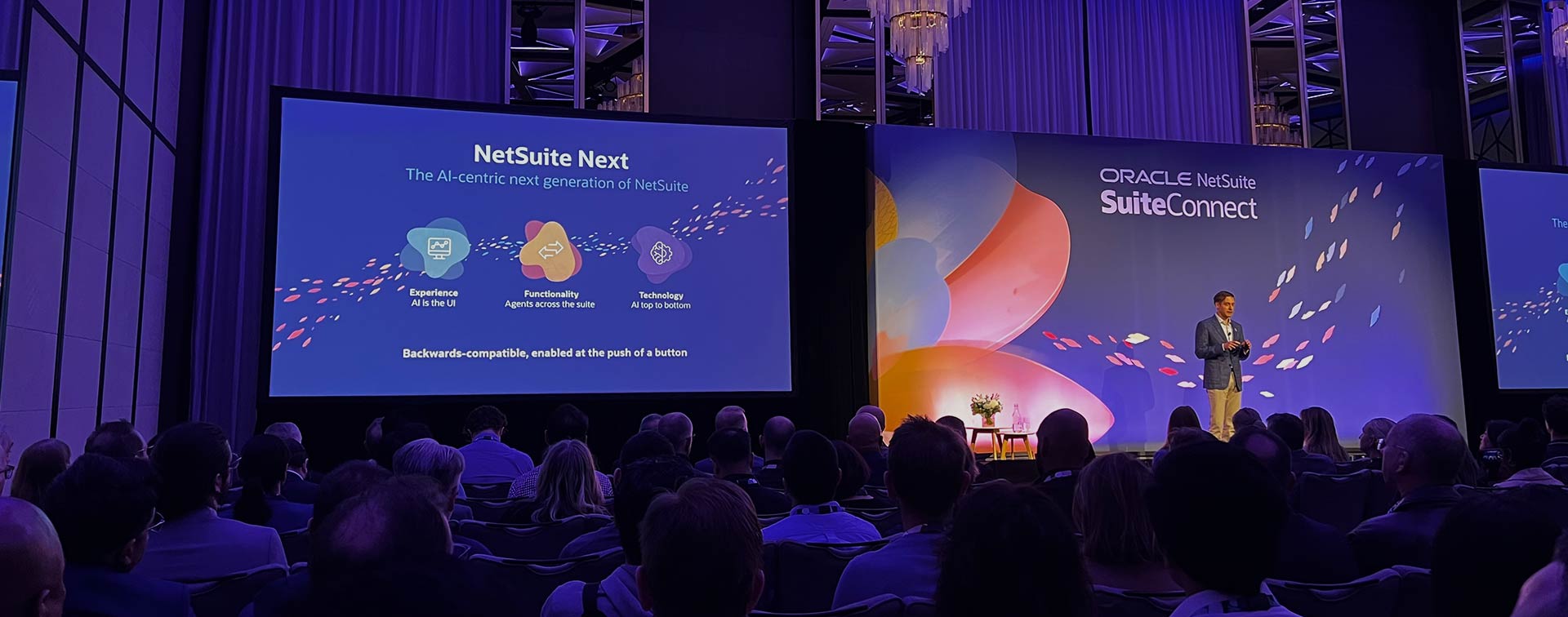
During his keynote, NetSuite founder Evan Goldberg declared, “ERP as we know it is over.”
 
It was a deliberately bold opening, followed by a vision of business software that does considerably more than record transactions, produce reports and wait for someone to tell it what to do.
 
Goldberg outlined three major changes:
The most interesting part of that vision isn’t the technology itself. It’s what happens when software understands the relationships between different parts of a business.
 
A supplier price increase affects purchasing costs. Those costs affect job margins. Reduced margins affect profitability and cash flow. A change in demand can alter inventory requirements, staffing and working capital.

Business leaders already understand these connections. Their challenge is having the information and capacity to assess them quickly enough. NetSuite’s latest developments point towards an ERP environment that can increasingly help with that work.

From seeing the numbers to understanding what’s behind them

One of the more practical SuiteWorld demonstrations involved a CFO investigating an unexpected decline in gross margin.
Using NetSuite Data Intelligence and Ask Oracle, the CFO explored financial information alongside marketing campaign data and the company’s discount policy. The demonstration identified three orders where combined discounts exceeded the company’s 12% policy limit without the required approval.
 
A conventional margin report can show that profitability has declined. Investigating the reason may require finance, sales and marketing teams to examine different records and piece together the explanation. In the demonstration, AI helped connect those sources, identify specific exceptions and give the CFO information to review.

For business leaders, that represents a potentially valuable change: moving more quickly from recognising a problem to understanding what caused it and deciding how to respond. It doesn’t remove the need for judgement. It helps bring the relevant information into the decision.

Knowing your margins is one thing. Knowing what’s driving them changes everything.

The same principle applies to the work happening on the ground

Consider a construction services business.

Materials are purchased, subcontractors are engaged and work progresses across multiple sites. Costs are incurred throughout delivery, but payment depends on accurate progress reporting, billing and customer approval. When project costs and billing information are managed separately, cash-flow problems can develop before they become obvious in financial reports.
 
At SuiteWorld, NetSuite demonstrated construction-specific capabilities that connected project progress, earned value, billing and payment applications. The system highlighted underbilling and assisted with preparing payment documentation, with a person reviewing and approving the action.
 
For an industrial equipment manufacturer, Goldberg described a Price Change Impact Agent designed to examine how an individual component price change affects margins and identify alternative purchasing options.
 
These examples are particularly relevant to the industries Klugo works with, including construction services, industrial equipment, manufacturing and field service. The underlying business problems are familiar, and the new opportunity is how connected information and AI-assisted analysis may help teams recognise and address them earlier.
 
These capabilities form part of NetSuite’s evolving product direction, with NetSuite Next and Ask Oracle already in preview with early Australian customers and a broader rollout to ANZ expected soon.

The SuiteWorld vision is ambitious, but businesses don’t need to introduce autonomous AI to begin improving how they operate. In fact, many of the benefits start with something more fundamental: bringing financial and operational information together in an integrated ERP system such as NetSuite.

You can start getting value before adopting advanced AI

When finance, purchasing, inventory, job management and billing operate from a consistent system of record, teams can understand how their decisions affect other parts of the business without having to manually piece together information from multiple applications.
 
For a field service business, that could mean connecting technician time, parts consumption and job completion directly with invoicing and financial reporting. For an equipment distributor, it might mean having purchasing commitments, stock availability and supplier costs visible alongside their financial impact. And for a construction business, it could mean bringing estimated costs, actual expenditure, project variations and billing into one reliable view.
 
These are improvements businesses can pursue today using established ERP capabilities, without waiting for advanced AI.
 
The value goes beyond reducing administration. When information is connected, a manager can see how an unexpected material cost affects job profitability, or how completed work that hasn’t been invoiced is affecting cash flow.
 
It’s also the foundation that makes AI more useful. If job costs aren’t consistently recorded, even a sophisticated AI assistant will struggle to give a complete picture of profitability. If approval responsibilities are unclear, asking an agent to perform more of the work introduces additional risk.
 
Getting the fundamentals right makes the next stage of AI adoption more attainable. Businesses can start with reliable data and processes, then gradually introduce tools that make the information easier to interrogate, interpret and act upon.
What does taking the next step actually look like?
 
Consider a field service business managing maintenance and installation work across multiple customer sites.
 
The business has a steady flow of work, but management occasionally discovers that jobs expected to be profitable have delivered much smaller margins than anticipated. There are also delays between completing jobs and issuing invoices, creating additional pressure on cash flow.
 
The leadership team wants to improve both outcomes. That doesn’t necessarily require an ambitious AI transformation. It starts with understanding why those problems occur.
First, connect the information behind each job.
 
Technician hours, parts used, subcontractor costs, purchase orders and job completion details all contribute to profitability. If these records sit in disconnected systems or aren’t captured consistently, identifying where costs have increased takes considerable effort.
 
An integrated ERP such as NetSuite can bring that information together, connecting operational activity with financial reporting. For a business without ERP, establishing that foundation may be the first significant step. For an existing NetSuite customer, the opportunity may be to review how well the current system captures those costs and whether the relevant workflows are being used consistently.
Next, make the information easier to use.
 
With reliable job information available, managers can begin reviewing estimated versus actual costs, identifying incomplete job records and tracking work that is ready to invoice.
 
A useful dashboard, saved search or exception alert may be enough to highlight where attention is needed. Where AI-assisted analysis is available, managers can begin asking more direct questions about job performance and exploring the underlying information.
 
This is a manageable way to introduce AI: start with questions the team already understands and can validate against known business records.
Then, look for opportunities to act earlier.
 
Once managers can reliably identify margin exceptions or billing delays, the business can consider how to respond more quickly.
 
Perhaps a workflow alerts the relevant manager when a job exceeds its estimated labour hours. Perhaps completed jobs with outstanding paperwork are automatically identified for follow-up. Or an AI-assisted tool helps investigate recurring patterns in jobs that regularly exceed their budgets.
 
Each improvement builds on the information and processes already in place, with clear measures of success such as fewer invoicing delays, reduced cost overruns or improved job margins.
Finally, consider where supported automation can take on more of the work.
 
As confidence grows, the business may identify activities that can be prepared or completed through automation, with appropriate approvals and oversight.
 
That could mean preparing routine documentation, recommending corrective actions or coordinating tasks between operational and finance teams. More advanced AI agents may eventually support larger parts of those workflows, provided the business has the necessary controls and confidence in the results.
 
The business doesn’t have to reach that stage to benefit. Better cost visibility, more consistent processes and faster invoicing can already make a meaningful difference.
 
The important point is that each step solves a real operational problem while preparing the business for what comes next.
What this means for existing NetSuite customers
 
One of the most relevant messages from SuiteWorld was that existing customers won’t necessarily need to rebuild their ERP to explore the next generation of functionality.
 
Goldberg described enabling Ask Oracle within existing environments and introducing NetSuite Next progressively by user or role. He also confirmed that the first Australian customers were already participating in a preview, with wider availability expected as the rollout continues.
 
But there’s no need to wait for Ask Oracle to begin exploring what AI can do with the business information already available in NetSuite.
Better information. Better business decisions.

The developments announced at SuiteWorld 2026 point towards a future where ERP can help businesses understand their performance, identify problems earlier and make more informed decisions.

Klugo helps businesses connect finance and operations, get more from NetSuite and improve visibility, efficiency and control to make better decisions and drive business growth.

Mark Culverson

Senior Sales Executive
LinkedIn

Make NetSuite work better for your business.

Looking to improve financial visibility, streamline operations or get more from your existing NetSuite system?

NetSuite’s AI Connector Service, built on Model Context Protocol (MCP), provides a practical starting point for existing customers. It allows supported AI tools, including Claude and ChatGPT, to interact with NetSuite data through a governed connection that respects user roles and permissions.
 
For businesses already using these tools, this opens up opportunities to ask questions about their own operational and financial information, explore patterns and assist with analysis, without first having to move data into disconnected spreadsheets or manually prepare it for an AI tool.
 
A finance leader might begin by asking which customer accounts need attention or exploring changes in expenses. An operations manager might examine outstanding orders or look for patterns in job performance. The questions can start small, with users reviewing the source information and testing the usefulness of the responses as they build confidence.
 
The AI Connector Service is available to NetSuite customers in ANZ, with access to particular tools and functionality depending on the configuration and permissions in their environment. It provides a useful opportunity to develop familiarity with AI-assisted analysis while NetSuite Next and Ask Oracle continue their rollout.
 
There’s also value in reviewing whether existing NetSuite functionality is being used as effectively as it could be. Sometimes the most useful improvement is a better workflow, more accurate cost allocation or a dashboard that finally gives the right person the information they need.
And for businesses considering their first ERP?
 
The case for integrated ERP remains grounded in the fundamentals of running a business.
 
Finance, purchasing, inventory, sales and operations all affect one another. When those activities depend on disconnected systems, people spend time reconciling information and coordinating decisions.
 
NetSuite’s unified platform brings financial and operational transactions together within a shared data environment, with an integrated general ledger at its core. Unlike architectures that rely on separate applications exchanging information in batches, transactions recorded within NetSuite can be reflected in financial and operational reporting as they occur. This reduces reconciliation delays and gives users, including supported AI tools, access to a more current and consistent view of the business.
 
Its evolving AI capabilities add another consideration: as business software becomes more conversational and capable of supporting actions, the quality and context of the information behind it become even more valuable. That doesn’t mean buying ERP for the promise of future AI features. It means evaluating whether an integrated platform can solve today’s operational problems while providing room to grow.
A stronger business is built one improvement at a time
 
SuiteWorld 2026 offered an ambitious view of how ERP could change. For ANZ businesses dealing with rising costs, constrained margins and working-capital pressures, the opportunity is to translate that vision into practical improvements.
 
Start with the decisions that matter. Understand the information and processes behind them, improve what isn’t working and introduce new capabilities when they can deliver measurable value.
 
At Klugo, we work with businesses to connect their financial and operational processes, improve how they use NetSuite and assess where new capabilities can make a practical difference.
 
The future of ERP may involve software taking on much more of the work. The goal remains straightforward: a business that can make better decisions, respond to change and operate profitably.

If you’re reviewing your ERP or wondering whether you’re getting enough from NetSuite today, talk to Klugo about the next improvement worth making.

Ready to see what NetSuite can do?

Optimising systems for smarter work.

Explore how we can get your tech stack growth-ready.

Industry experts, certified developers, agile process. We value mateship, teamwork, and creating lasting partnerships.

More Blogs

Smarter Buildings Need Smarter Suppliers

Smarter buildings need smarter suppliers. At FM Connect 2026, meet Klugo’s Steve Paea to talk about how NetSuite connects finance, projects, inventory, customers and field service as facilities businesses grow and become more complex.

Read more

Discover Klugo’s NetSuite Experience. Join forces with us for technology that supports growth and creates value.