Written by Kristin Steele, Klugo CEO
What getting over my own resistance to AI taught me about embracing change, trusting technology, and leading a business through it.
I wasn’t sure where to start with AI. Frankly, with all the talk about autonomous agents and robots taking over, I was half expecting the world of “I, Robot” to arrive by 2027. Which, by the way, is only two months away. Where did 2026 go?
With all the predictions about jobs disappearing and AI taking over entire business processes, I had a bit of a head-in-the-sand moment. I could see that something significant was happening, but I wasn’t entirely sure I wanted to jump in.
The irony wasn’t lost on me. As a business leader, I pride myself on having a growth mindset, being open to new ideas and encouraging our team to challenge how things are done. Yet here I was, resisting a change that was going to happen whether I participated or not.

At some point, I had to acknowledge that reluctance. If I wanted to keep growing as a leader and help our business do the same, I couldn’t sit on the sidelines waiting until everything felt comfortable. I needed to understand the technology well enough to make informed decisions about where it could help us.
So I challenged myself to get started. Not by developing some grand AI strategy, but by figuring out how I could make it useful in my own working day.
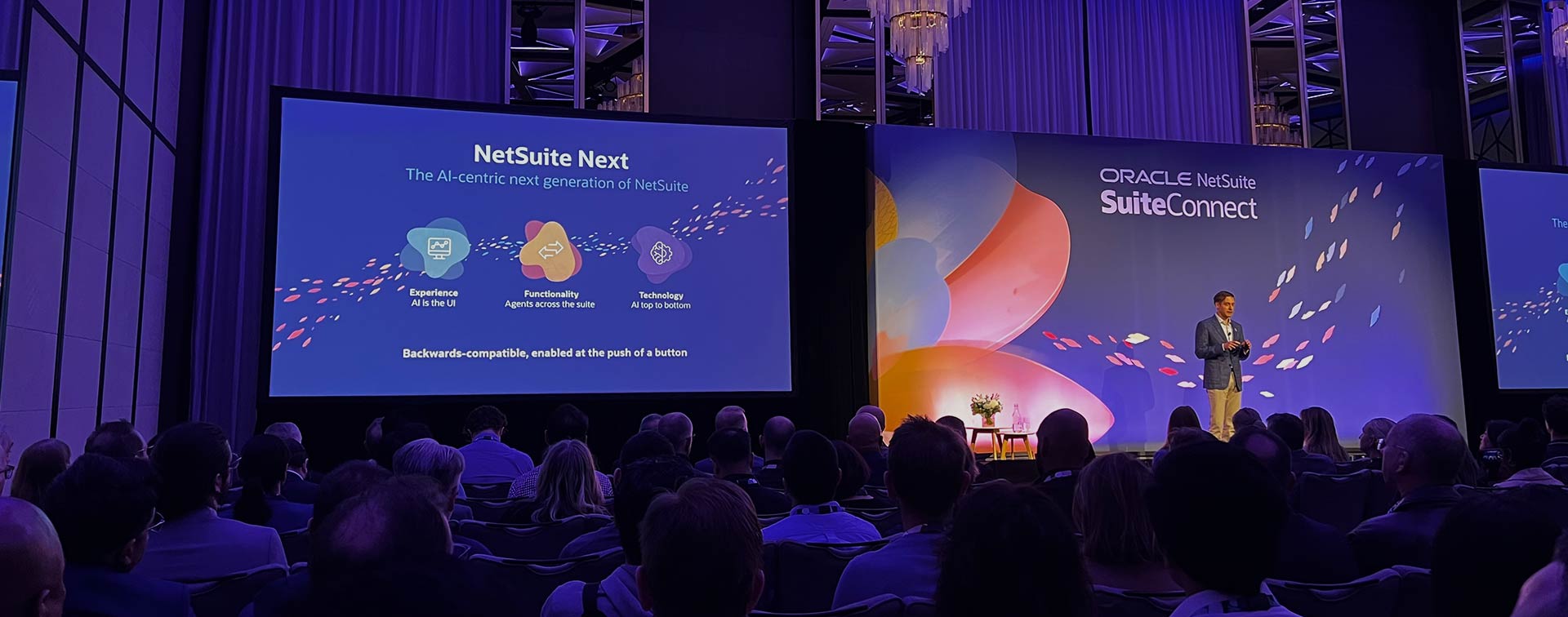
Recently, while listening to Evan Goldberg‘s keynote at NetSuite’s SuiteWorld 2026, I found myself reflecting on that journey and how much my perspective has changed.

Goldberg described a future where business systems don’t simply wait for instructions. These systems increasingly understand the context behind our operations, help identify what needs attention, and take on more of the work that people would otherwise have to manage.
It’s an exciting vision, and one that feels closer than I expected. But as a CEO, I’m also thinking about what it means for our people, our customers, our processes, and the decisions we’re ultimately accountable for.
Starting small was the best thing I could have done. My first steps with AI weren’t particularly sophisticated.
Sure, I used it to draft emails. Quite a few emails, actually. But I also started using it to research topics, summarize information and help me analyze things I was already working on.
These were tasks where I could assess the results myself. I wasn’t handing over a decision or giving the technology responsibility for a business process. I was simply exploring whether it could help me work more efficiently and improve the quality of what I produced.
Over time, I discovered something I hadn’t fully appreciated at the beginning. The value wasn’t necessarily just getting an answer faster. It was what I could do with the time I saved.
Research and analysis that previously might have taken hours could be explored much more quickly, leaving me with time to ask more questions, challenge the findings and investigate things I might otherwise have overlooked. Instead of stopping when I had enough information to make a decision, I could explore the issue more thoroughly, test alternative approaches and consider the implications from different perspectives.
That additional depth became just as valuable to me as the time saved.
From answering questions to challenging my thinking
Today, one of the most useful ways I work with AI is as a critical thinking partner. I’ll ask it to challenge an assumption, identify weaknesses in an argument or examine a situation from a perspective I might have overlooked.
Sometimes it confirms my thinking. Sometimes it raises a question that changes how I approach a problem.
I’ve also started creating my own AI skills for some of these activities, building on the ways I regularly approach research, analysis and decision-making. There are already plenty of skills and tools available to help people use AI as a critical thinking partner, but I’ve found value in experimenting with approaches that suit how I work.
And I don’t always rely on just one AI model.
I like using different large language models (LLMs) to challenge one another’s reasoning, test conclusions and expose weaknesses in an argument. One model might identify an assumption another has overlooked, or approach the same information from a different perspective.
I’m conscious that AI responses can reflect biases in the information they’re trained on, as well as assumptions and biases I introduce through the way I frame my own questions. Over time, the context a tool builds around how I work can also influence the responses I receive.
Using more than one model doesn’t guarantee an unbiased or accurate answer, but it can be a useful way to challenge the thinking rather than simply accept the first response that sounds convincing.
I still need to verify the information, apply my own experience and exercise judgment. What has changed is my confidence in knowing when these tools can add value, where their limitations are and how to use them more deliberately.
That confidence developed through practical use. I started with manageable activities, learned what worked and gradually expanded how I used the technology.
And that raises an important question for me as a business leader: If I needed time, patience and the freedom to experiment before I became comfortable with AI, am I giving our people the same opportunity?
We can’t assume everyone will immediately see the value or feel confident experimenting with unfamiliar technology. People need room to explore, ask questions, make mistakes, challenge the results and discover what works for their own roles.
If we want our teams to embrace new ways of working, we need to enable that learning rather than simply expect adoption. And we need to recognize that confidence develops at different speeds for different people.
What if we approached business AI the same way?
During the SuiteWorld keynote, Goldberg demonstrated how NetSuite is evolving from a traditional ERP platform into something that can increasingly help people understand business information, coordinate activities and carry out supported work.
One example involved a CFO investigating a decline in gross margin. The AI connected financial information with marketing campaign data and company policies, helping identify transactions that needed review.
Another demonstration showed how a construction business could connect project progress with billing information, helping identify potential cash-flow issues and prepare payment documentation.
These are meaningful developments, but I don’t think the takeaway for business leaders should be that we suddenly need to automate everything.
For me, the more useful question is: What’s one responsibility we could make easier for our people today, and how would we know whether the change was working?
One of the most important things we can do as leaders is give our people the information, tools and confidence they need to succeed in their roles. Our teams understand the day-to-day challenges of their work, often better than anyone else. When they have access to reliable information and the freedom to contribute their expertise, they’re better equipped to identify problems, suggest improvements and make good decisions.
AI can play a valuable role in that. Perhaps it’s helping an operations manager understand job costs without waiting for several reports. Perhaps it’s giving a finance team more time to investigate exceptions rather than manually assembling information. Or perhaps it’s helping a customer-facing employee access the information they need to resolve an issue more quickly.
These may sound like small improvements, but their impact can extend well beyond the individual task. People who feel supported and equipped to do their jobs are better positioned to contribute, take ownership and deliver good work. That benefits the team, the business and ultimately the customer experience.
It’s also a far more approachable place to start than trying to redesign the entire business around AI.
There’s a difference between trusting AI to advise and trusting it to act
One distinction has become increasingly important to me as I’ve explored AI: trusting AI to help you think differently is different from trusting AI to act on behalf of your business.
When I’m using AI for research, analysis or to challenge my thinking, I’m still deciding what to do with its output. I can question it, verify the information, reject a suggestion or simply use it to explore another perspective. The responsibility for the decision remains with me.
Allowing an AI agent to create a financial transaction, change a purchasing workflow or take action on behalf of the business is another level of responsibility entirely. An incorrect recommendation is one thing. An incorrect action that affects a customer, supplier or employee can have consequences that are much harder to undo.
That doesn’t mean we should avoid these capabilities. It means the confidence required to use them needs to be supported by more than a few successful experiences.
Before giving AI that responsibility, we need to understand what information it’s working with, how its conclusions can be verified, what it’s authorized to do and when a person needs to step in. We need clear permissions, approvals and accountability, just as we would with any other important business process.
Our people also need to understand how their roles may change. If AI takes on some routine work, we have an opportunity to give employees more time for activities that benefit from their experience, judgment and expertise. But that requires leadership, communication and involving the people affected in shaping how the technology is used.
For me, the goal isn’t to remove people from the process simply because technology can perform a task. It’s to understand where technology can genuinely help them perform their roles more effectively.
Trust is something we build through evidence, experience and appropriate controls. And the more responsibility we give the technology, the more important those controls become.
What changes when AI already understands your business?
Another part of Goldberg’s keynote reinforced just how quickly these capabilities are developing.
When I use AI for research or analysis today, I often spend time providing the background information it needs to understand my question. I explain the circumstances, share relevant information and clarify the context so it can produce a more useful response.
What NetSuite is demonstrating is a significant progression from that experience.
As AI becomes more deeply embedded in business systems, much of that context can already be available through the information, processes, policies and relationships the system manages. Rather than having to explain everything from scratch, we can increasingly work with technology that already has a meaningful understanding of how the business operates.
And that context matters because business decisions rarely affect just one department.
A decision about sales can affect inventory requirements. Purchasing decisions influence margins and working capital. Operational delays can affect billing, cash flow and customer relationships.
As a CEO, I can’t consider those decisions in isolation. There are direct and indirect consequences across the business, and understanding those relationships is part of making informed decisions.
The opportunity I see is for AI to increasingly help make those connections, bringing together relevant information, identifying potential consequences and offering a useful starting point for analysis or action.
That doesn’t mean the system will always interpret everything correctly, or that we should stop questioning its recommendations. But it does suggest that some of the effort we currently spend gathering information and explaining business context could increasingly be handled by the technology itself.
And that makes the potential applications much more tangible.
We don’t have to solve the whole future today
I’m more comfortable using AI now than I was when I started. That doesn’t mean I have all the answers or that I’m ready to hand over every business process to an agent. It means I’ve learned enough through practical use to recognize applications and use cases I wouldn’t necessarily have considered before.
Perhaps the biggest lesson for me has been recognizing that I needed to apply the growth mindset I encourage in others to my own relationship with technology.
I didn’t have to become an AI expert overnight. I needed to be willing to learn, to experiment and to be uncomfortable for a little while. Once I did that, I began recognizing opportunities that previously felt well beyond my reach.
And I think the same applies to the businesses we lead.
We can be curious without being careless. We can challenge the way we work without changing everything at once. We can give our teams opportunities to experiment, learn and suggest improvements while maintaining the responsibilities and controls that matter.
For some businesses, that journey might begin with adopting an integrated ERP system that brings financial and operational information together. For others, it could mean making better use of the NetSuite platform they already have or exploring how AI can help their teams work with the information that’s available.
At Klugo, we’ve been reflecting on these developments following SuiteWorld and what they could mean for Australian and New Zealand businesses.
Our latest article looks at how NetSuite’s evolving capabilities can support stronger, more resilient and profitable operations, and why the most valuable improvements don’t necessarily need to be the biggest ones.
The technology will continue to develop, probably faster than any of us can comfortably keep up with. Our responsibility as leaders is to understand which developments are genuinely useful for our businesses, how they affect our people and where to invest our attention.
I’m still not entirely sure how far AI will take us. But I’ve moved past wondering whether I should get started and begun asking what else we could use it for.
And while I’m keeping an eye out for the robots, I’m much more interested in what our people could achieve with the right tools behind them.
I’d be interested to hear from other business leaders: Was there a moment when you realized you needed to move from watching AI develop to actually giving it a go?
From AI sceptic to AI advocate.
AI is changing how we work, make decisions and lead our teams. But knowing where to start isn’t always easy.
In this article, Klugo CEO Kristin Steele shares her experience of moving from uncertainty to practical AI adoption, and what it taught her about leadership, trust and giving people the confidence to embrace change.
Exploring what AI could mean for your business?
At Klugo, we help businesses build stronger foundations with NetSuite, connect their people and processes, and explore new capabilities that deliver practical value.

Mark Culverson
Senior Sales Executive
LinkedIn
Make NetSuite work better for your business.
Looking to improve financial visibility, streamline operations or get more from your existing NetSuite system?